While studying for his entrance exam to the National University for Aerospace Magic, Harry Coandă became interested in magical paper airplanes.
Unfortunately, Harry Coandă doesn't have any magic paper at hand so he needs your help with some experiments.
Unfortunately, Harry Coandă doesn’t have any magic paper at hand so he needs your help with some experiments.
Harry designed experiments to study the flight path of his airplane. An experiment consists of a room of length and height that can be represented as an grid, and wall-like obstacles each with a hole through it. Each wall is placed at distance from the left side of the room and has a hole
starting at height and going up to height . The airplane starts on the far left end of the room at height and needs to reach the far right end of the room without crashing into walls, the floor, or the ceiling.
Unlike a normal paper airplane, Harry’s magical plane doesn’t rely on gravity or air, instead it moves from left to right with a constant horizontal speed of unit per second. Its vertical speed is initially but once every second it can instantly increase or decrease its vertical speed by unit per second. Help Harry by telling him for each experiment whether the plane can take a path to the end of the room without crashing, or if a crash is inevitable
Input data
The first line of the input file contains a single integer , the number of test cases. test cases follow, each preceded by an empty line.
Each test case consists of:
- a line containing integers , , : the width of the room, the height of the room, and the number of obstacles respectively.
- a line containing the integers : the X coordinates of the walls.
- a line containing the integers : the lower Y coordinates of the holes.
- a line containing the integers : the upper Y coordinates of the holes.
Output data
The output file must contain lines corresponding to the test cases, each consisting of a string: YES if the airplane can reach the end of the room without crashing, or NO otherwise.
Constraints and clarifications
- .
- .
- .
- for each .
- for each .
- The sum of over the testcases does not exceed .
Your program will be tested against several test cases grouped in subtasks.
In order to obtain the score of a subtask, your program needs to correctly solve all of its test cases.
| # | Points | Constraints |
|---|---|---|
| 1 | 0 | Examples |
| 2 | 5 | . |
| 3 | 7 | . |
| 4 | 13 | |
| 5 | 19 | . |
| 6 | 9 | . |
| 7 | 14 | . |
| 8 | 33 | No additional constraints. |
Example
stdin
3
19 10 3
3 9 14
8 0 4
9 1 7
19 15 3
4 7 12
4 13 4
4 14 11
10 16 1
3
0
2
stdout
YES
NO
NO
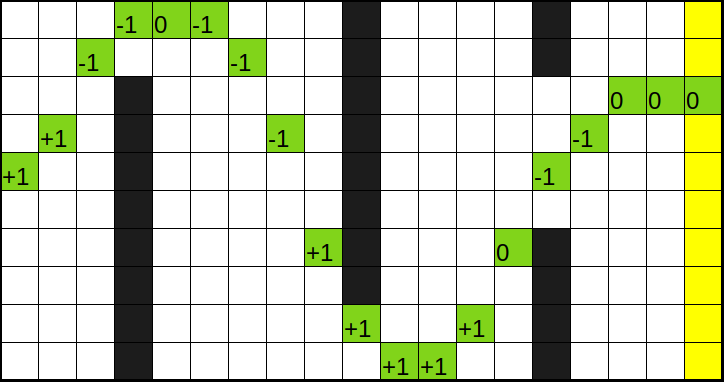
In the first sample case, it is possible for the airplane to reach the end. One possible path is shown in
the figure. Visited cells are colored in green, with , and representing the vertical speed changes
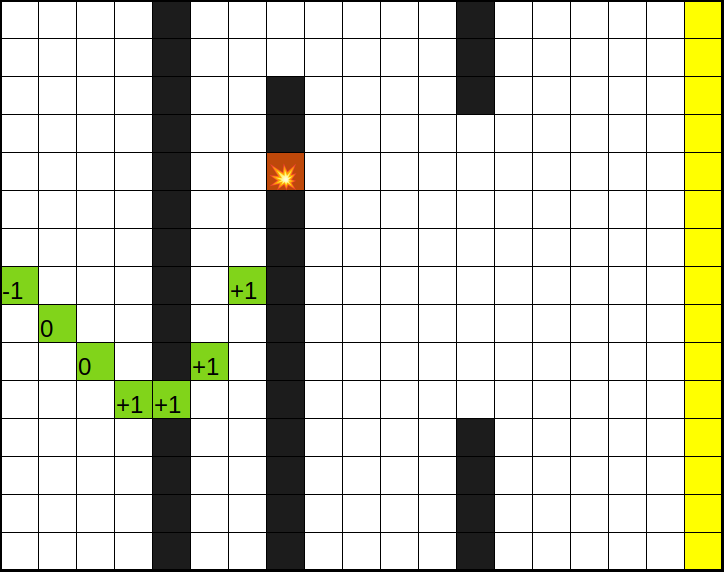
In the \textbf{second sample case} it is impossible for the plane to reach the end without crashing. A path where the plane crashes into the second wall is shown.
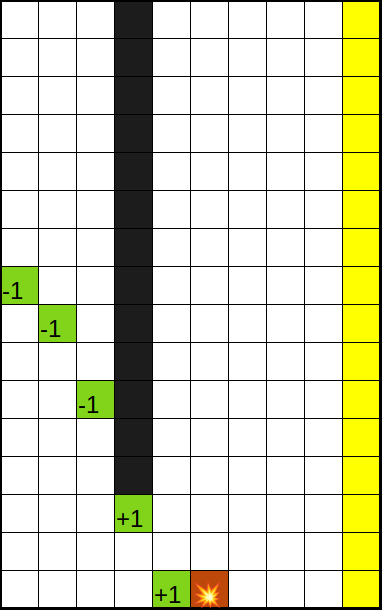
In the \textbf{third sample case} it is again impossible to reach the end without crashing. A path where the plane crashes into the floor is shown. Note that plane can hover right above the floor, but if it any moment the height gets below 0 the plane crashes. (Similarly, the plane can crash into the ceiling if the height reaches at least ).