Following the international success of the Cipizz pizzeria in Craiova, the good friends Dani, Andrei and Ștefan have each decided to open a new pizzeria of their own in Romanescu Park. The park is represented as a binary matrix with rows and columns (indexed from ), where means a free cell, and indicates the presence of a tree. Each of them wants to place his pizzeria in a free cell (a cell marked with ). The park in the image will be represented as follows:
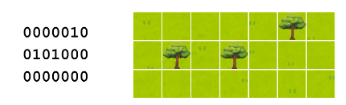
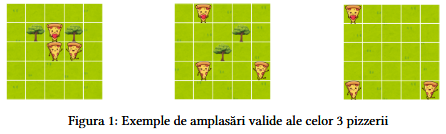
Moreover, there is a villain, Chilly Willy, who wants to sabotage their pizzerias, which is why they have decided to place their pizzerias at distinct points such that each of them has the other pizzerias in sight, meaning that for any two pizzerias, there must be no tree on the straight line between them. Also, in order to maximize their profit, the of them have deduced that the optimal placement of the pizzerias must form an isosceles right triangle with one leg on a row, one leg on a column, with the hypotenuse on a pseudo-diagonal parallel to the main diagonal, and with the angle at the bottom-left corner. Below you can see a few examples of such valid placements:
Requirement
To make a long story short, Bogdănel is responsible for handling all of this, and he asks you to find out in how many ways we can place the pizzerias so that the mentioned criteria are respected (or, formally, how many triangles of the required shape, with an all- perimeter, exist in this binary matrix).
Implementation Details
You must implement the function
int count_triangles(int N, int M, std::vector<int> x, std::vector<int> y);
which receives as parameters:
- and , the dimensions of the matrix;
- and , vectors of size , meaning that there is a tree in the matrix at position for .
The function must return the number of ways the pizzerias can be placed, modulo . The judge will call the function exactly once per test.
Constraints and Notes
- and ,
- The positions of the trees are distinct.
| # | Score | Constraints |
|---|---|---|
| 1 | 2 | |
| 2 | 3 | |
| 3 | 14 | |
| 4 | 7 | |
| 5 | 7 | and |
| 6 | 5 | |
| 7 | 31 | |
| 8 | 7 | |
| 9 | 9 | |
| 10 | 15 | No additional restrictions. |
Example
input
3 7 3
2 2
1 6
2 4
output
6
Explanation
Here are the 6 possible solutions:
0000x10  0000x10  0000010  0000010  0000010  0000010
0101xx0  0101xx0  x101000  01x1000  0101x00  01010x0
0000000  0000xxx  xx00000  00xx000  0000xx0  00000xx